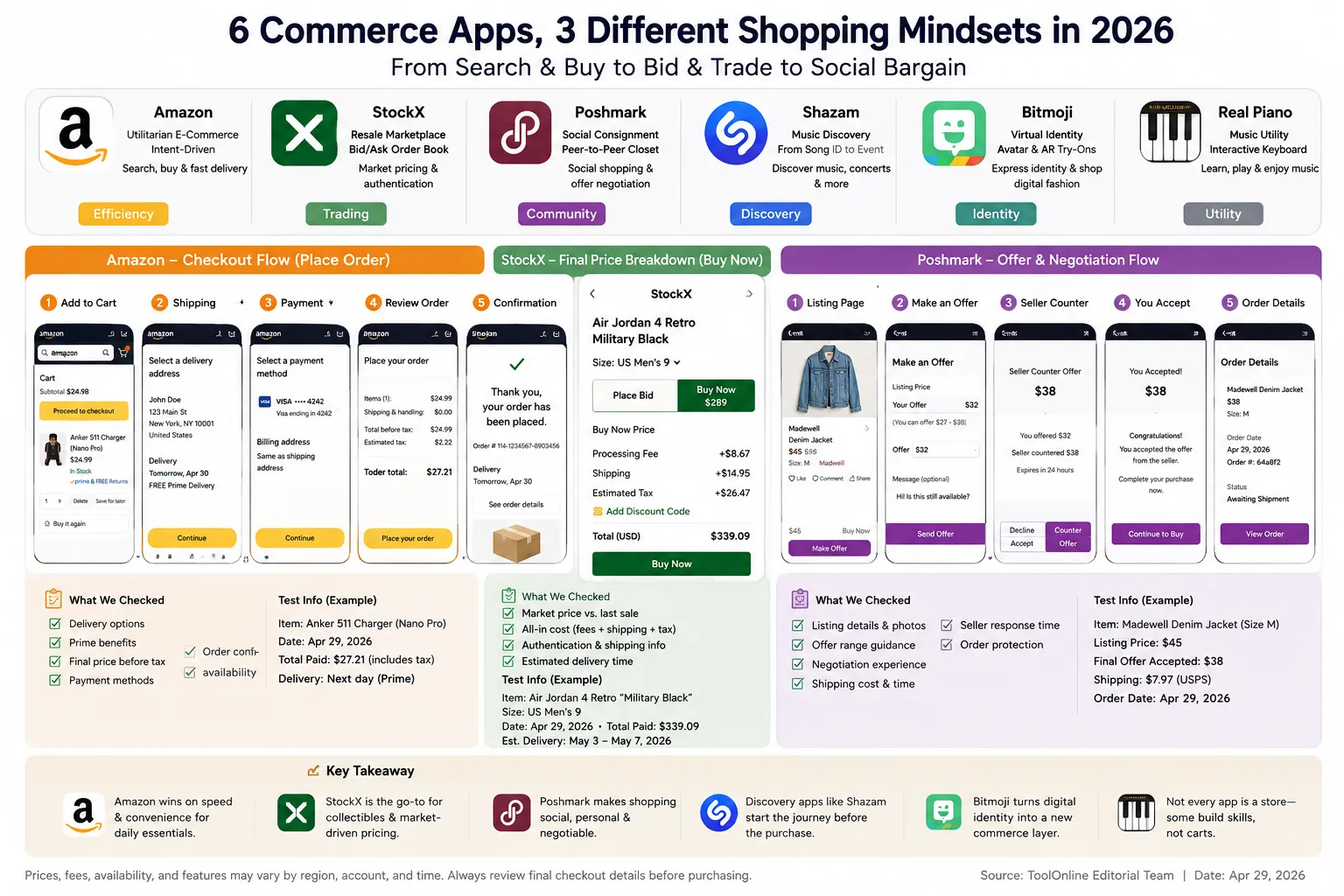
Stock-Market Sneakers, Social Closets, and Shopping Before Checkout: 6 Commerce Apps Compared
Some shopping apps feel like vending machines.
You know exactly what you need, enter a search term, tap Buy Now, and wait for the package.
Others feel like trading floors, neighborhood flea markets, concert-discovery engines, or digital dressing rooms. The product may be physical, second-hand, virtual—or not even available for purchase until the app first creates the desire for it.
That is the more interesting story of mobile commerce in 2026.
Amazon, StockX, and Poshmark may all help users acquire products, but they are built around very different behaviors:
-
Amazon reduces the time between intent and delivery.
-
StockX turns resale prices into visible market signals.
-
Poshmark turns personal wardrobes into social storefronts.
-
Shazam connects an unidentified song to artists and live events.
-
Bitmoji treats clothing as part of a digital identity.
-
Real Piano demonstrates where the “commerce app” label becomes too broad to remain useful.
For this editorial comparison, we examined how each app creates, captures, or completes a purchase decision. We focused on price visibility, trust, discovery, social interaction, transaction friction, and what happens after the user first opens the app.
Quick Comparison: Six Different Roles in the Commerce Journey
| App | Primary role | Commerce model | What it does best | Main limitation |
|---|---|---|---|---|
| Amazon Shopping | Direct retail | Search, checkout and delivery | Fast repeat and intent-driven purchases | Convenience can discourage comparison |
| StockX | Verified resale marketplace | Offers, Asks and market pricing | Price discovery for collectible products | Fees and resale risk require careful review |
| Poshmark | Social peer-to-peer resale | Closets, sharing, offers and bundles | Browsing second-hand fashion socially | Item quality depends on individual sellers |
| Shazam | Discovery-to-commerce bridge | Music recognition and concert discovery | Turning an unknown song into an artist journey | Not a complete ticketing or merchandise platform |
| Bitmoji | Virtual identity commerce | Avatar fashion and digital items | Expressing identity through digital clothing | Virtual outfits are not physical try-ons |
| Real Piano | Learning and entertainment utility | Ads, subscriptions or app access | Practising notes and chords on a phone | It is not meaningfully a shopping marketplace |
The table intentionally avoids a universal numerical score. A score such as 9.5/10 is not very useful unless the article explains the tasks, devices, account plans, regions, fees and scoring formula behind it.
How We Compared the Apps
Instead of asking which app had the most features, we looked at the job each app was designed to complete.
A credible comparison should examine:
-
How quickly the user can reach a useful result
-
Whether the total price is clear before payment
-
How the platform handles trust and verification
-
Whether discovery is based on intent, recommendations or social activity
-
How much manual effort is required
-
Whether the app encourages considered purchasing or impulse behavior
-
What buyer protections and limitations apply
These are not identical products, so a single speed test would be misleading. Finding household batteries on Amazon cannot be measured in the same way as identifying a song with Shazam or evaluating a collectible on StockX.
1. Amazon Shopping: The Vending Machine of Mobile Commerce
Amazon is the baseline for utilitarian shopping because its workflow begins with an assumption:
The user already knows that something needs to be purchased.
A typical Amazon session is not necessarily about entertainment or community. It may involve replacing detergent, ordering a cable, buying office supplies, or repurchasing something that has run out.
The Amazon Shopping app currently includes real-time delivery tracking and notifications. Amazon also offers repeat-purchase tools such as Buy Again, while Prime delivery options can include same-day service in eligible US ZIP codes. Availability still depends on the item, address and account. (亚马逊)
Why the experience feels efficient
Amazon reduces friction through:
-
Saved addresses
-
Stored payment methods
-
Previous-order history
-
Delivery estimates
-
Product variations
-
Reviews and questions
-
Repeat-order shortcuts
-
Shipment notifications
The result is a shopping experience that often feels closer to replenishing inventory than visiting a store.
Where convenience becomes a weakness
Speed can hide comparison costs.
A product appearing first in search is not necessarily:
-
The lowest-priced option
-
The highest-quality option
-
Sold by the manufacturer
-
Available under the best return conditions
-
The cheapest after unit-price comparison
-
The most suitable version
Users should still examine the seller, product dimensions, recent reviews, delivery date, return policy and final checkout total.
Editorial verdict
Amazon is strongest when the purchase is functional and time-sensitive.
It is less distinctive when shopping is supposed to feel social, collectible or exploratory. Amazon helps users finish a purchase; it does not always help them understand why they want the item in the first place.
2. StockX: A Trading-Floor Interface for Collectibles
StockX does not present every item like a conventional retail product.
On its Verified Marketplace, buyers can purchase immediately at the lowest available Ask or submit an Offer. Sellers can accept the current highest Offer through Sell Now or create an Ask and wait for a matching buyer. (stockx.com)
This vocabulary matters.
Words such as Offer, Ask, market price and sales history encourage users to think about timing and valuation—not only whether they like the shoe, bag, card or collectible.
StockX also provides sellers with historical sales information and pricing guidance based partly on recent marketplace activity. (stockx.com)
How verification works
For standard Verified Marketplace transactions, eligible items may be sent to a StockX Verification Center and checked against the platform’s condition guidelines before being shipped to the buyer. Some inventory can also ship through approved StockX Verified Sellers or pre-verified channels, so it is not accurate to claim that every single order always follows exactly the same physical route. (stockx.com)
The original statement that authenticators check “glue smell” should be removed unless StockX itself documents that specific procedure.
Do sneakers become investments?
StockX makes products look more financial, but that does not make them regulated financial assets.
A resale price can fall because of:
-
Restocks
-
Changing trends
-
Product condition
-
New releases
-
Declining buyer interest
-
Platform fees
-
Shipping expenses
-
Regional demand
Buyer fees can also vary by marketplace, price, buyer location and market conditions. On some transaction types, additional processing, shipping, taxes or optional verification charges may apply. (stockx.com)
A product selling for more than retail does not guarantee that an individual buyer can later resell it profitably.
Editorial verdict
StockX is best understood as a marketplace with trading-style interaction, not a stock exchange.
Its great innovation is price visibility. Its great risk is making a consumer purchase feel more financially rational than it may actually be.
3. Poshmark: The Social Closet Sale
If StockX resembles a price terminal, Poshmark resembles a closet sale where every rack belongs to a different person.
Sellers build individual Closets, publish listings and share items with followers. Shared listings can appear in follower feeds, while buyers can discover sellers whose size and fashion taste resemble their own. (Poshmark)
This changes the emotional structure of shopping.
The user may arrive without searching for a specific SKU. They may instead follow a seller, like an outfit, browse a themed event or discover an item through another person’s styling choices.
The social mechanisms
Poshmark currently supports:
-
Individual seller Closets
-
Followers and feeds
-
Listing sharing
-
Likes
-
Size-based discovery
-
Bundles
-
Seller bundle discounts
-
Themed Posh Parties
Poshmark states that Parties take place in the app multiple times per day, allowing qualifying listings to be shared into themed events. Sellers can also create automatic bundle discounts when a buyer purchases multiple items. (Poshmark)
A more realistic comparison task
To evaluate Poshmark properly, search for one second-hand item with defined criteria:
Product: Wool coat
Size: Medium
Maximum budget: $100
Condition: Good or better
Color: Black or dark grey
Then record:
-
Number of relevant listings
-
Accuracy of size filters
-
Quality of photographs
-
Seller description detail
-
Response time to a question
-
Offer and counteroffer process
-
Shipping cost
-
Return limitations
-
Final amount paid
That creates real evidence of how the social marketplace performs.
The trust model
StockX builds trust around centralized verification and condition rules.
Poshmark relies more heavily on:
-
Seller photographs
-
Written descriptions
-
Buyer questions
-
User history
-
Social reputation
-
Platform transaction protections
That does not make Poshmark inherently less trustworthy. It means the buyer needs a different skill set.
A second-hand buyer should inspect:
-
Stains
-
Fabric wear
-
Missing labels
-
Alterations
-
Measurements
-
Odor disclosures
-
Authenticity evidence
-
Signs that photographs were copied
Editorial verdict
Poshmark is not simply a cheaper clothing store.
Its real product is the combination of inventory, individual taste, negotiation and social proof. Shopping feels personal because another person—not an anonymous warehouse—selected and photographed the item.
4. Shazam: Commerce Begins Before the Product Search
Shazam is not a traditional shopping app.
Its main function remains music recognition: identifying a song playing nearby or inside supported apps. It also helps users explore artists, lyrics and concerts. Apple’s current Shazam support materials allow users to discover nearby or personalized concert listings, while Apple Music and Maps can surface event information connected through Shazam’s concert-discovery system. (App Store)
That makes Shazam interesting from a commerce perspective.
The purchase journey can begin before the user knows the product name.
The discovery sequence
A typical path is:
Hear song
→ Identify artist
→ Save or stream track
→ Explore artist
→ Discover nearby show
→ Open ticket information
The user did not open the app intending to shop. The app converted curiosity into a potentially commercial action.
Editorial verdict
Shazam shows that commerce does not begin at checkout.
It begins at recognition: the moment an anonymous sound becomes a named artist, event or experience that the user can pursue.
5. Bitmoji: Clothing as Digital Identity
Bitmoji also sits outside conventional e-commerce.
Its core purpose is to create a personal cartoon avatar and use that avatar in stickers, Snapchat and other messaging experiences. (bitmoji.com)
The commercial layer appears through digital fashion.
Inside Snapchat, users can browse Bitmoji clothing, save items to a virtual closet and, for certain releases, claim fashion items using Snap Tokens. Snap notes that some items are unavailable in certain countries and that token-based clothing may only work inside Snapchat. (support.bitmoji.com)
Why digital clothing matters
Physical apparel solves practical problems such as comfort and protection.
Avatar clothing communicates:
-
Taste
-
Mood
-
Group identity
-
Cultural references
-
Aspirational brands
-
Seasonal participation
-
Online status
The user is not dressing a physical body. They are editing how they appear in conversations and digital spaces.
What Bitmoji is not
Bitmoji should not be described as a virtual fitting room unless a specific feature genuinely places physical products on the user’s body or predicts real-world fit.
Changing an avatar’s outfit does not tell the user:
-
Whether a shirt fits
-
How a fabric drapes
-
Whether a color matches real skin tone
-
What size to order
-
How an item looks under real lighting
It is digital identity styling, not physical apparel simulation.
Editorial verdict
Bitmoji’s significance is not that users will buy every outfit in real life.
Its significance is that fashion brands can occupy a person’s digital identity before any physical purchase occurs.
6. Real Piano: The App That Exposes the Classification Problem
Real Piano is the least convincing member of this shopping-app list—and that is exactly why it is useful.
Current app-store descriptions present Real Piano as a mobile instrument and learning utility for practising piano keys, chords and notes. (Google Play)
It may contain:
-
Advertising
-
In-app purchases
-
Subscription prompts
-
Links to related learning content
-
Features that encourage interest in a real keyboard
But that does not make it a shopping marketplace.
Why including it without explanation hurts the article
Almost every consumer app has some connection to commerce.
A weather app may recommend umbrellas.
A fitness app may influence shoe purchases.
A piano app may encourage the purchase of a keyboard.
If that is enough to classify every app as shopping-related, the category stops meaning anything.
A better editorial use
Treat Real Piano as a control case:
How direct must a commercial pathway be before an app becomes commerce-adjacent?
Real Piano can create product demand indirectly, but its primary workflow remains learning or entertainment.
Editorial verdict
Real Piano should not receive a shopping-app score beside Amazon or StockX.
Keep it in the article only when the purpose is to explain the boundary between an app that sells, an app that influences purchases and an app that merely belongs to a consumer category.
Six Apps, Five Different Shopping Behaviors
The most useful conclusion is not that one app is “best.”
It is that each app activates a different type of consumer behavior.
1. Need-based shopping
Amazon
The user knows what they need and wants the transaction completed with minimal effort.
2. Price-and-status shopping
StockX
The user cares about rarity, timing, historical prices and the possibility that value may change.
3. Social discovery shopping
Poshmark
The user discovers products through people, wardrobes, sharing and negotiation.
4. Curiosity-driven commerce
Shazam
The app identifies something the user could not previously name and opens a path toward an event or media experience.
5. Identity-driven virtual consumption
Bitmoji
The product exists primarily as part of the user’s digital self-presentation.
6. Indirect commercial influence
Real Piano
The app may increase interest in hardware or lessons, but purchasing is not the main workflow.
The Buyer’s Reality Check
Regardless of the interface, ask five questions before paying.
What is the final price?
Include:
-
Shipping
-
Processing fees
-
Taxes
-
Import duties
-
Authentication charges
-
Subscription renewal
-
In-app currency
The most visible price is not always the price paid.
Who is actually selling the item?
The seller may be:
-
The platform
-
A third-party business
-
An individual
-
A verified marketplace participant
-
A digital-content publisher
The answer affects returns, warranties and dispute handling.
What exactly is being purchased?
It may be:
-
A physical item
-
A used item
-
A ticket
-
A digital garment
-
A subscription
-
Access to a feature
-
An app-store currency
Can the purchase be reversed?
Check:
-
Return eligibility
-
Cancellation timing
-
Refund method
-
Condition requirements
-
Digital-item restrictions
-
Marketplace dispute rules
Is the purchase useful—or merely urgent?
Countdown timers, price graphs, likes, limited drops and social sharing all create pressure in different ways.
A sophisticated interface can still encourage a very ordinary impulse purchase.
Final Verdict
The most important shopping apps in 2026 do not all look like stores.
Amazon compresses the distance between need and delivery.
StockX makes price history and buyer-seller matching part of the product experience.
Poshmark transforms second-hand inventory into a social network of personal Closets.
Shazam demonstrates how recognition can become the first step toward ticket and entertainment commerce.
Bitmoji moves fashion into digital identity, where an outfit can have expressive value without physically existing.
Real Piano reminds us not to label every consumer app as a shopping platform merely because it may eventually influence a purchase.
Mobile commerce is no longer only about where checkout happens.
It is about where desire begins, how trust is created and what type of behavior the interface teaches the user to repeat.
Frequently Asked Questions
Is StockX really like a stock market?
It borrows market-style mechanisms such as Offers, Asks, historical sales information and automatic matching. However, the products are consumer goods, not regulated securities, and resale profits are not guaranteed. (stockx.com)
Does every StockX item go through a verification center?
Many Verified Marketplace transactions involve StockX verification, but some eligible products may be pre-verified or dispatched through StockX Verified Sellers. Buyers should review the specific marketplace and shipping information. (stockx.com)
Why is Poshmark described as social commerce?
Users can follow other members, share listings into feeds, browse Closets, join themed Parties and create bundles. Social activity is therefore part of product discovery and selling. (Poshmark)
Can Shazam sell concert tickets?
Shazam can help users discover concerts and reach related event information. The exact ticket provider and availability depend on the artist, event and region. (苹果支持)
Is Bitmoji a virtual try-on app?
No. It allows users to dress an avatar, but that is not the same as predicting the fit or appearance of physical clothing on the real user.
Why include Real Piano in a commerce article?
It works best as a boundary case. It can influence purchases related to music learning, but its primary purpose is playing and practising music rather than shopping.