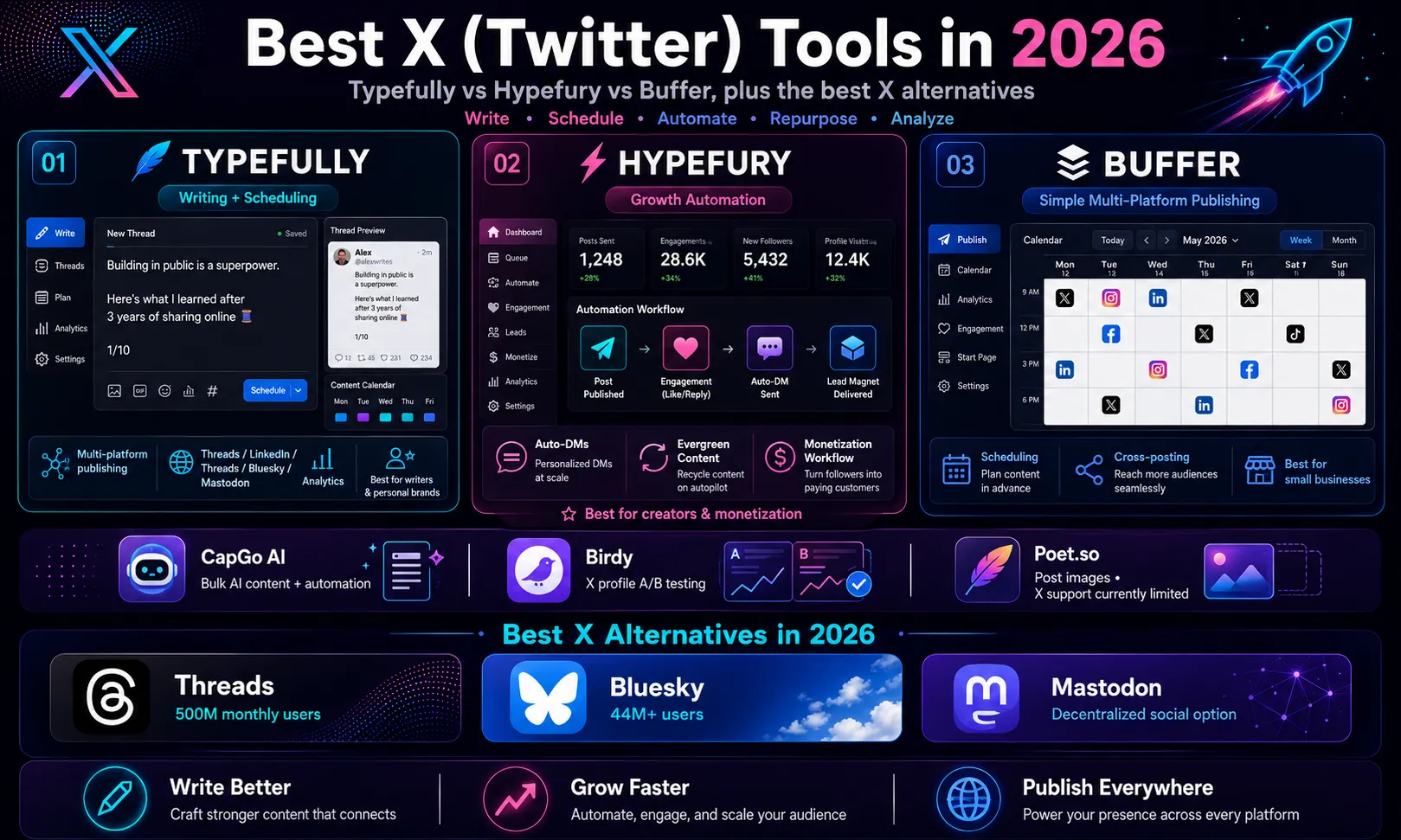
Best X (Twitter) Tools in 2026: Typefully vs Hypefury vs Buffer, Plus the Best X Alternatives
Posting consistently on X is easy in theory.
In practice, anyone trying to grow a personal brand, company account, newsletter, or creator business quickly runs into the same problems:
What should I post today?
Should this idea be a single post or a thread?
When should I publish it?
How do I reuse the same idea on LinkedIn, Threads, or Bluesky without manually rewriting everything?
And after publishing for several months, how do I know which content is actually helping the account grow?
That is why a large ecosystem of third-party X tools still exists in 2026.
Some focus on writing.
Some focus on scheduling.
Others automate distribution, analyze profile conversion, generate content at scale, or help creators turn an audience into email subscribers and customers.
At the same time, X is no longer the only major text-first social platform worth considering.
Threads has grown rapidly, Bluesky has established a substantial user base around its open social network, and Mastodon remains an important option for people who prefer decentralized social media.
So this guide covers both sides of the question:
Which tools can make X easier to manage?
And:
Which platforms should you consider if you want to expand beyond X?
Quick Answer: The Best X Tools in 2026
| Tool | Best For | Main Strength |
|---|---|---|
| Typefully | Writers, founders and personal brands | Writing, scheduling and analytics |
| Hypefury | Creators focused on growth and monetization | Automation, Auto-DMs and evergreen content |
| Buffer | Small businesses managing several social platforms | Simple multi-platform publishing |
| CapGo AI | Marketers producing content at scale | Bulk AI content and multi-channel automation |
| Birdy | Creators optimizing X profile conversion | Profile A/B testing |
| Poet.so | Social post image creation | Useful for several platforms, but X support is currently limited |
If your priority is writing better X posts, start with Typefully.
If your priority is automating growth and monetization, Hypefury is more specialized.
If X is only one of several platforms you manage, Buffer is usually the simpler choice.
If you are producing dozens or hundreds of pieces of content across SEO, GEO and social channels, CapGo AI belongs to a different, more automation-heavy category.
Why Use a Third-Party Tool for X?
X itself already lets you write posts, view analytics and interact with your audience.
So why add another tool?
Because publishing is only one part of content marketing.
A serious creator workflow often looks more like this:
Idea → Draft → Edit → Schedule → Publish → Repurpose → Analyze → Reuse
The native X interface can handle some of those steps.
Specialized tools attempt to make the entire system more efficient.
For example, instead of remembering to publish six times during the week, you can prepare the content in one session and schedule it.
Instead of copying an X post into LinkedIn, Threads and Bluesky manually, you can use a cross-posting workflow.
Instead of abandoning a good post after one publication, some tools can automatically recycle evergreen content later.
The goal is not to automate your personality.
It is to automate the repetitive parts surrounding it.
1. Typefully: Best for Writing and Scheduling X Content
Typefully originally became popular because of its clean writing experience for Twitter threads.
By 2026, it has expanded considerably.
The platform currently supports X posts and threads as well as publishing workflows for LinkedIn, Threads, Bluesky and Mastodon. It also includes scheduling, AI writing assistance, content ideas, analytics and collaboration features.
This makes it especially attractive to people whose primary activity is writing.
Think:
-
founders;
-
indie hackers;
-
consultants;
-
writers;
-
newsletter creators;
-
marketers;
-
personal brands.
The Writing Experience
Typefully is designed to remove much of the clutter surrounding social publishing.
You can start with an idea, turn it into a longer thread, rearrange sections and preview what the final post will look like.
AI features can help generate ideas or rewrite content, but that should be treated as editing assistance rather than a replacement for your own voice.
That distinction matters.
One of the easiest ways to make a social account forgettable is to fill it with generic AI-written posts that sound like everyone else's.
The strongest use of an AI writing assistant is often:
Your idea → AI helps edit it
rather than:
AI invents everything → publish immediately
Typefully itself warns users that AI-generated content should be reviewed before publishing.
Scheduling and Cross-Posting
Typefully can schedule X posts and threads and also supports cross-platform publishing.
Its current account structure can connect X, LinkedIn, Threads, Bluesky and Mastodon accounts, allowing a creator or team to manage several destinations from one environment.
That matters because many creators are no longer building on one platform.
An idea might begin as:
one X thread
and later become:
-
a LinkedIn post;
-
a Threads post;
-
a Bluesky post;
-
a newsletter section.
Cross-posting should not always mean publishing identical text everywhere.
Different networks have different cultures.
But having the same original draft available across platforms removes a lot of repetitive work.
Analytics
Typefully also provides X analytics.
Current metrics include areas such as impressions, engagements, engagement rate and profile conversion rate. (Typefully Help Center)
This makes it possible to answer questions more useful than:
“Did this post get a lot of likes?”
For example:
“Which topics consistently generate profile visits?”
or:
“Which posts turn impressions into actual engagement?”
That is more valuable for long-term growth.
Typefully is best for:
Creators who want a clean place to write, schedule, analyze and repurpose social content without turning their workflow into a large marketing automation system.
2. Hypefury: Best for Growth Automation and Monetization
Typefully emphasizes the writing experience.
Hypefury leans harder into growth automation.
Its current feature set includes scheduling, evergreen posts, automatic reposting, AutoPlugs, Auto-DMs, cross-platform repurposing and analytics.
That makes it particularly interesting for creators who use X as part of a business funnel.
For example:
X post → engagement → DM → lead magnet → email list
or:
X content → product promotion → landing page
Auto-DMs
One of Hypefury's more distinctive tools is Auto-DM automation.
A creator might publish:
“Reply GUIDE and I'll send you my free creator checklist.”
Instead of manually messaging every person who responds, an automation can deliver the resource.
This can be useful for:
-
lead magnets;
-
newsletter acquisition;
-
free templates;
-
product launches;
-
community invitations.
Hypefury currently supports Auto-DM campaigns as part of its growth toolkit.
However, automation needs to be used carefully.
Aggressive or irrelevant automated messaging can quickly feel like spam.
The most sustainable workflow is usually one where the user deliberately asks for something and automation simply delivers it.
Evergreen Content
Social posts disappear quickly from people's feeds.
That creates an interesting question:
If a post was genuinely useful six months ago, why should it only be published once?
Hypefury supports recurring and evergreen publishing workflows as well as automated reposting.
This is especially useful for creators whose content remains relevant for a long time.
Examples include:
-
writing advice;
-
business frameworks;
-
productivity lessons;
-
educational threads;
-
product tips.
But not everything should be recycled.
A post saying:
“Breaking news: X launched this feature today”
obviously should not reappear six months later.
Automation works best with evergreen ideas, not time-sensitive content.
Hypefury is best for:
Creators who want X to generate more than impressions—particularly people building newsletters, selling products or turning social engagement into leads.
3. Buffer: Best for Managing X Alongside Other Platforms
Buffer is less X-specific.
That is actually its strength.
If you manage:
-
X;
-
Instagram;
-
Threads;
-
LinkedIn;
-
Mastodon;
-
other social channels,
you may not want a tool built primarily around one social network.
Buffer lets users create, schedule and analyze X content while managing other social platforms inside the same system. It also supports scheduled X threads and an AI writing assistant.
Why Buffer Is Good for Small Businesses
Imagine a small ecommerce company.
Its marketing team needs to publish:
-
a product announcement on X;
-
a visual post on Instagram;
-
a company update on LinkedIn;
-
a discussion post on Threads.
The company probably does not need sophisticated X creator monetization tools.
It needs:
one reliable publishing calendar.
That is where Buffer makes sense.
The experience is closer to a traditional social media management platform than a creator-growth engine.
One limitation worth knowing is that X's own platform rules affect what third-party schedulers can do.
For example, Buffer currently notes that X posts can only be scheduled to one X account at a time through its workflow, and duplicate posting is restricted by X's guidelines.
That is a useful reminder that third-party X tools are always partly dependent on X's API and automation policies.
Buffer is best for:
Small businesses, agencies and social media managers who consider X one channel among several, rather than the center of their creator business.
4. CapGo AI: Best for High-Volume Content Automation
CapGo AI belongs in this list, but it should not be presented as a direct Typefully competitor.
Its scope is much broader.
CapGo currently focuses on generating and distributing content across:
-
social media;
-
SEO;
-
GEO/AEO;
-
email;
-
websites.
Its workflow uses a spreadsheet-style interface where users can generate content in bulk and distribute it to platforms including X, LinkedIn, Reddit and Medium.
That creates a very different use case.
Typefully asks:
“How can I write this post well?”
CapGo is closer to:
“How can I execute this content workflow 100 times?”
When Does That Make Sense?
Imagine an agency manages 20 products.
For every product it needs:
-
one blog article;
-
five social posts;
-
one LinkedIn post;
-
several GEO-oriented content pieces;
-
email copy.
Doing this through individual chat prompts becomes difficult to manage.
A structured bulk workflow can be more useful.
This is therefore less about personal-brand craftsmanship and more about marketing operations at scale.
The obvious risk is quality.
Producing content faster does not automatically make it useful.
If you use bulk AI generation, human review becomes even more important.
CapGo AI is best for:
Marketing teams, agencies and growth teams building large, repeatable content pipelines across more than one channel.
5. Birdy: An Interesting Tool for X Profile A/B Testing
Most social media tools optimize posts.
Birdy focuses on something different:
the profile people see after clicking your name.
Its current product allows users to create variations of an X/Twitter profile and compare which version converts more visitors into followers or website clicks.
Birdy can test elements including:
-
bio;
-
profile picture;
-
banner;
-
name;
-
location;
-
website.
This addresses an overlooked part of social growth.
Suppose one of your posts receives 100,000 impressions.
That does not automatically mean you gain many followers.
People may visit your profile and still leave.
The problem could be:
-
unclear positioning;
-
weak bio copy;
-
confusing banner;
-
no clear reason to follow;
-
poor website CTA.
In that situation, publishing more content may not fix the real bottleneck.
Profile conversion does.
Birdy is best for:
Creators who already receive meaningful profile traffic and want to systematically improve the percentage of visitors who follow or click through.
For a brand-new account receiving almost no profile visits, however, A/B testing will naturally be less useful because there is little traffic to measure.
6. What About Poet.so?
Poet.so became known for turning social posts into attractive shareable images.
That format is useful because a successful text post can become:
-
an Instagram image;
-
a blog graphic;
-
a LinkedIn visual;
-
a newsletter screenshot.
However, there is an important 2026 caveat.
Poet's website currently states that because of changes to Twitter's API, creating Poet images directly from Tweets is temporarily unavailable. It still supports content from other services including LinkedIn and several review platforms.
So I would not currently describe Poet.so as the best X/Twitter image converter.
That could change if X integration returns.
This is also a good example of why articles about social media tools need regular updates.
API changes can remove an important feature almost overnight.
X Tool Comparison Table
| Feature | Typefully | Hypefury | Buffer | CapGo AI | Birdy |
|---|---|---|---|---|---|
| X scheduling | Excellent | Excellent | Excellent | Yes | No |
| Thread creation | Excellent | Excellent | Good | AI-generated | No |
| AI writing | Yes | Yes | Yes | Major focus | No |
| Cross-platform publishing | Excellent | Excellent | Excellent | Excellent | No |
| Auto-DMs | Limited/feature-dependent | Major strength | No | Not core | No |
| Evergreen automation | Some automation | Excellent | Scheduling-focused | Workflow automation | No |
| X analytics | Excellent | Yes | Yes | Campaign-oriented | Profile conversion |
| Profile A/B testing | No | No | No | No | Excellent |
| Bulk content generation | Moderate | Moderate | Limited | Excellent | No |
| Best use case | Writing | Growth | Social management | Scale | Conversion |
Which X Tool Should You Choose?
Choose Typefully if writing is the bottleneck
If you frequently have ideas but struggle to turn them into polished posts and threads, Typefully is probably the most natural place to start.
It combines creation, scheduling and analytics without adding too much complexity.
Choose Hypefury if monetization is the bottleneck
If you already post consistently but want to turn engagement into:
-
newsletter subscribers;
-
leads;
-
product sales;
-
recurring content distribution,
Hypefury's automation features become more relevant.
Choose Buffer if managing platforms is the bottleneck
If you are managing six social accounts and constantly switching between apps, Buffer solves a simpler operational problem.
You are buying convenience and centralization.
Choose CapGo AI if scale is the bottleneck
If the problem is:
“We need 200 content assets across several channels,”
a bulk automation platform becomes much more attractive than a writing-focused social tool.
Choose Birdy if profile conversion is the bottleneck
If posts already send significant numbers of people to your profile but few become followers, optimize the profile instead of simply increasing publishing frequency.
Best Alternatives to X in 2026
You may not actually need an X tool.
You may need a second distribution channel.
Three platforms are particularly relevant in 2026.
1. Threads: Best for Mainstream Reach
Threads has become much larger than the experimental Twitter alternative it was at launch.
Meta announced in June 2026 that Threads had reached 500 million monthly active users.
Its biggest strategic advantage remains its relationship with Instagram.
Creators who already have an Instagram presence enter an ecosystem where identity and audience discovery are much more closely connected than starting from zero on a completely independent social network.
Threads has also continued developing community and feed-control features.
Consider Threads if:
You are a creator, consumer brand, media account or public personality already active on Instagram and want another large text-and-conversation network.
2. Bluesky: Best for Open Social Networking and Feed Control
Bluesky takes a very different approach.
It is built on the AT Protocol, an open social networking protocol that allows independent developers and services to build on top of the network.
Bluesky also gives users unusual control over how they consume content through custom feeds.
Instead of relying entirely on one ranking algorithm, users can install feeds created by different developers and communities.
The network is no longer tiny either.
Bluesky says that as of May 2026 it had more than 44 million users.
Consider Bluesky if:
You care about open protocols, customizable feeds, developer ecosystems or want an X-like public conversation experience without depending entirely on a single centralized recommendation system.
3. Mastodon: Best for Decentralization and Community Control
Mastodon is based on a federated model.
Instead of one company running the entire network, independent servers can participate in a broader social ecosystem.
Mastodon is free and open source and uses ActivityPub to communicate across the wider fediverse. Its official project also emphasizes that Mastodon does not serve advertising in the way mainstream commercial social networks do.
This creates much more community autonomy.
It also creates additional complexity.
New users may need to understand:
-
servers;
-
federation;
-
local moderation rules;
-
how accounts interact across servers.
That learning curve is part of the trade-off.
Consider Mastodon if:
You care strongly about open-source software, federation, chronological feeds and community-managed social spaces.
X vs Threads vs Bluesky vs Mastodon
| Platform | Best For | Main Advantage | Main Trade-Off |
|---|---|---|---|
| X | News, creators, founders and public discussion | Established network and real-time conversation | Platform/API changes can affect workflows |
| Threads | Mainstream creators and Instagram users | Large audience and Meta ecosystem | Less independent from a large centralized platform |
| Bluesky | Open-social users and tech communities | AT Protocol and custom feeds | Smaller network than major mainstream platforms |
| Mastodon | Decentralization advocates and niche communities | Open source and federated | Greater onboarding complexity |
Should You Leave X or Cross-Post?
For most creators, this is probably the wrong decision:
Delete X and move everything somewhere else immediately.
A lower-risk strategy is:
Keep X → test one additional network → compare results
For example:
Month 1
Publish your best content to X and Threads.
Track:
-
impressions;
-
replies;
-
profile visits;
-
followers;
-
website clicks.
Month 2
Add Bluesky if your audience appears relevant there.
Month 3
Decide whether maintaining all three networks produces enough value.
A tool such as Typefully, Buffer or Hypefury can reduce the operational cost of that experiment because all three increasingly support multi-platform workflows.
One Important Warning About Social Automation
Do not confuse automation with growth.
Automation can help you:
-
publish consistently;
-
reuse content;
-
distribute content;
-
deliver requested resources;
-
analyze results.
It cannot automatically create a reason for people to care.
An account publishing 10 generic AI-generated posts per day is not necessarily stronger than an account publishing three useful original posts per week.
The most valuable inputs still come from humans:
-
experience;
-
opinions;
-
observations;
-
expertise;
-
examples;
-
stories;
-
data.
The software should reduce repetitive work around those ideas.
It should not become the source of every idea.
Final Verdict
There is no single “best X tool” because the products solve different problems.
Typefully is the strongest starting point for creators who care primarily about writing, scheduling and understanding content performance.
Hypefury becomes more attractive when X is part of a growth or monetization funnel and automation such as evergreen posting and Auto-DMs matters.
Buffer is a better fit when X is simply one channel inside a larger social media operation.
CapGo AI targets a more automation-heavy workflow where teams need to generate and distribute content at scale.
Birdy tackles a narrower but interesting problem: improving the conversion rate of an X profile once people arrive there.
And if your concern is no longer tooling but platform dependence, Threads, Bluesky and Mastodon each offer increasingly credible alternatives.
The simplest strategy for most creators in 2026 is therefore:
Create original ideas.
Use software to reduce repetitive publishing work.
Measure what actually works.
And avoid depending entirely on one social platform.
Frequently Asked Questions
What is the best tool for scheduling X posts?
Typefully, Hypefury and Buffer all support X scheduling.
Typefully is particularly well suited to creators and writers, Hypefury adds more growth automation, while Buffer is designed around multi-platform social management.
What is the best X tool for writing threads?
Typefully remains one of the strongest options for writing and scheduling threads because its interface was originally designed around long-form X/Twitter writing.
It now also supports X Articles for eligible X Premium accounts.
What is the best X tool for getting leads?
Hypefury is particularly interesting for lead-generation workflows because of its Auto-DM and AutoPlug features.
However, automated messaging should only be used in ways that remain relevant and compliant with platform automation rules.
Can Buffer schedule X threads?
Yes.
Buffer currently supports drafting and scheduling X/Twitter threads.
Can Typefully publish to platforms besides X?
Yes.
Typefully currently supports social accounts including X, LinkedIn, Threads, Bluesky and Mastodon, although the exact content formats available vary by platform. (
Is Poet.so still working with X?
Not fully at the moment.
Poet's website currently states that because of Twitter API changes, creating Poet images directly from Tweets is temporarily unavailable
That feature may return later.
Is Bluesky decentralized?
Bluesky is built on the open AT Protocol and supports federation, custom feeds and composable moderation.
It differs architecturally from Mastodon's ActivityPub-based fediverse, so the two should not simply be described as identical decentralized social networks.
Is Mastodon ad-free?
The official Mastodon project says it does not serve ads or push profiles into users' feeds and emphasizes chronological, user-controlled timelines.
Individual third-party servers can have their own operating models and policies.